$44,300 of monthly waste, found in one evening
Stephan Ochse ·
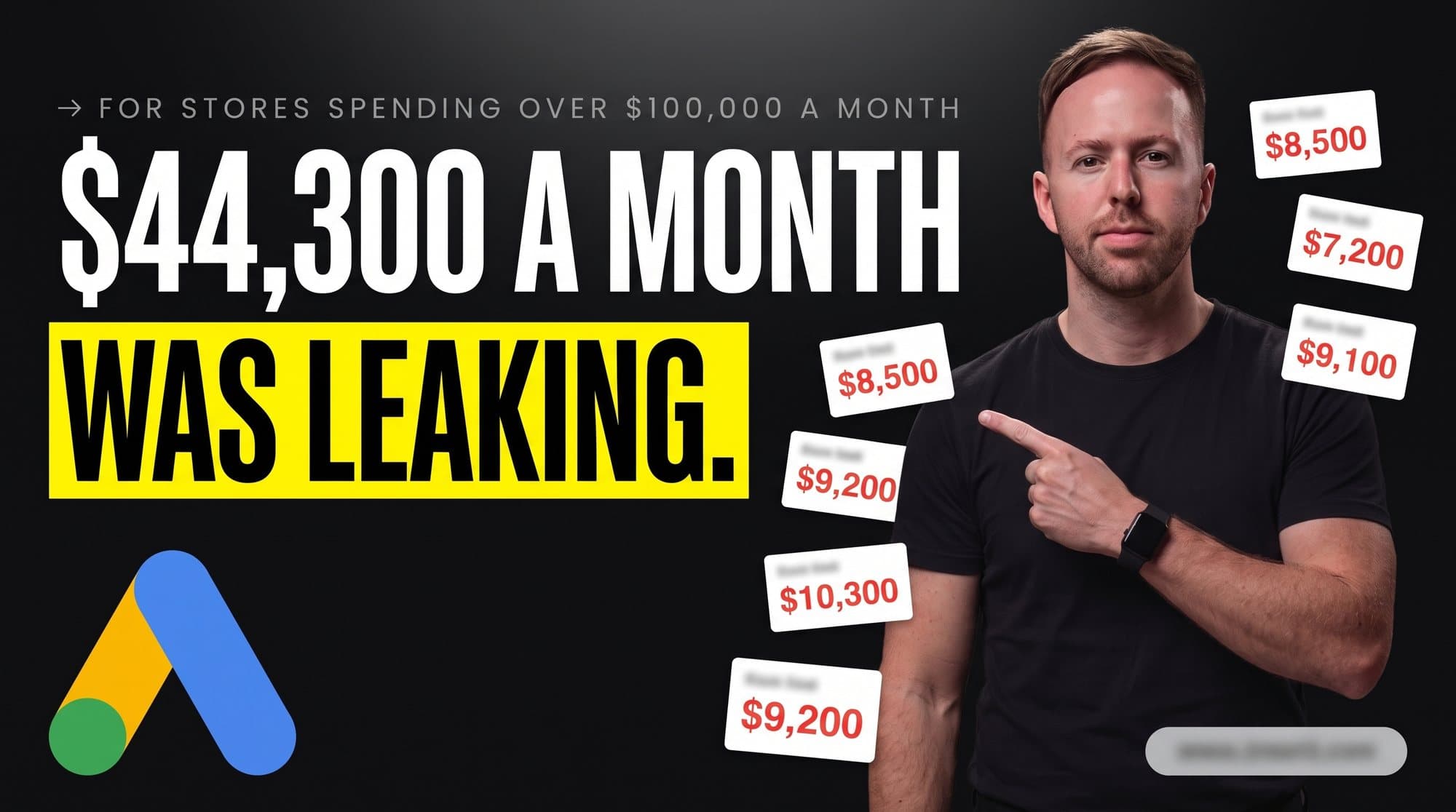
At 6:12pm on a Tuesday, an ecommerce founder gave me read-only access to a Google Ads account spending $520,000 a month. By 9pm the case file was built: $44,300 a month leaking through four separate holes, none of which appeared anywhere in the agency's monthly report he'd been reading for two years.
This edition is that case file, opened page by page. Names and identifiers blurred, mechanics fully visible, because the mechanics are what transfer to your account. For context, I run 100+ accounts at $300k to $2.5M a month through audit systems and AI agents, and evenings like this one are why: the 223-point audit ran in about 40 minutes. The other two and a half hours were me confirming each flag by hand, because a flag isn't a finding until a person has checked it against the account's reality.
[IMAGE-1: Clean case-study dashboard illustration on an off-white #FAF7F2 background, the edition's main image, styled as a case file summary sheet: a slim charcoal header band across the top reading exactly "CASE FILE: ONE EVENING, ONE ACCOUNT" with a small red tag chip beside it reading "$44,300/MO FOUND", beneath it two large side-by-side metric cards, the left card with a thin red top border, an eyebrow label reading "BEFORE", a huge charcoal figure reading "2.3x" and a caption reading "conversion-time ROAS, $520k/mo spend", the right card with a thin emerald top border, an eyebrow label reading "AFTER 60 DAYS", a huge emerald figure reading "3.4x" and a caption reading "same budget, four leaks closed", and below the two cards a horizontal row of four small evidence chips reading exactly "Geo bleed $9,400", "Network defaults $8,200", "Auto-applied keywords $14,700", "Out-of-stock PMax $12,000", each chip with a small red left border, flat clean design, generous spacing, no gradients, no photography, no logos, no border, all visible text real correctly spelled words, no people, no faces, bottom tenth of the frame left clean for the footer composite.]
**The before picture**
The interface story was fine: click-time ROAS a bit under 3.9x, spend pacing on plan, monthly report full of green arrows. The conversion-time story, measured the way I measure everything, was 2.3x on $520,000 a month. Not a disaster. A middle-of-the-pack ecommerce account with a middle-of-the-pack agency, which is exactly the profile where waste hides best, because nothing is on fire and nobody goes looking.
The founder didn't come to me because something broke. He came because growth had flatlined at a spend level where every extra dollar seemed to buy less. That symptom, flat at scale, is almost always leaks, not ceilings.
**Exhibit A: paying for countries they don't ship to**
The location settings on eleven campaigns sat on the default: presence or interest. That setting spends money on people who've shown interest in the target country, not only people in it. This store ships to one country. The audit cross-referenced spend by user location against the shipping policy and found $9,400 a month landing on users the store could never sell to, spread thin enough across campaigns that no single line ever looked alarming.
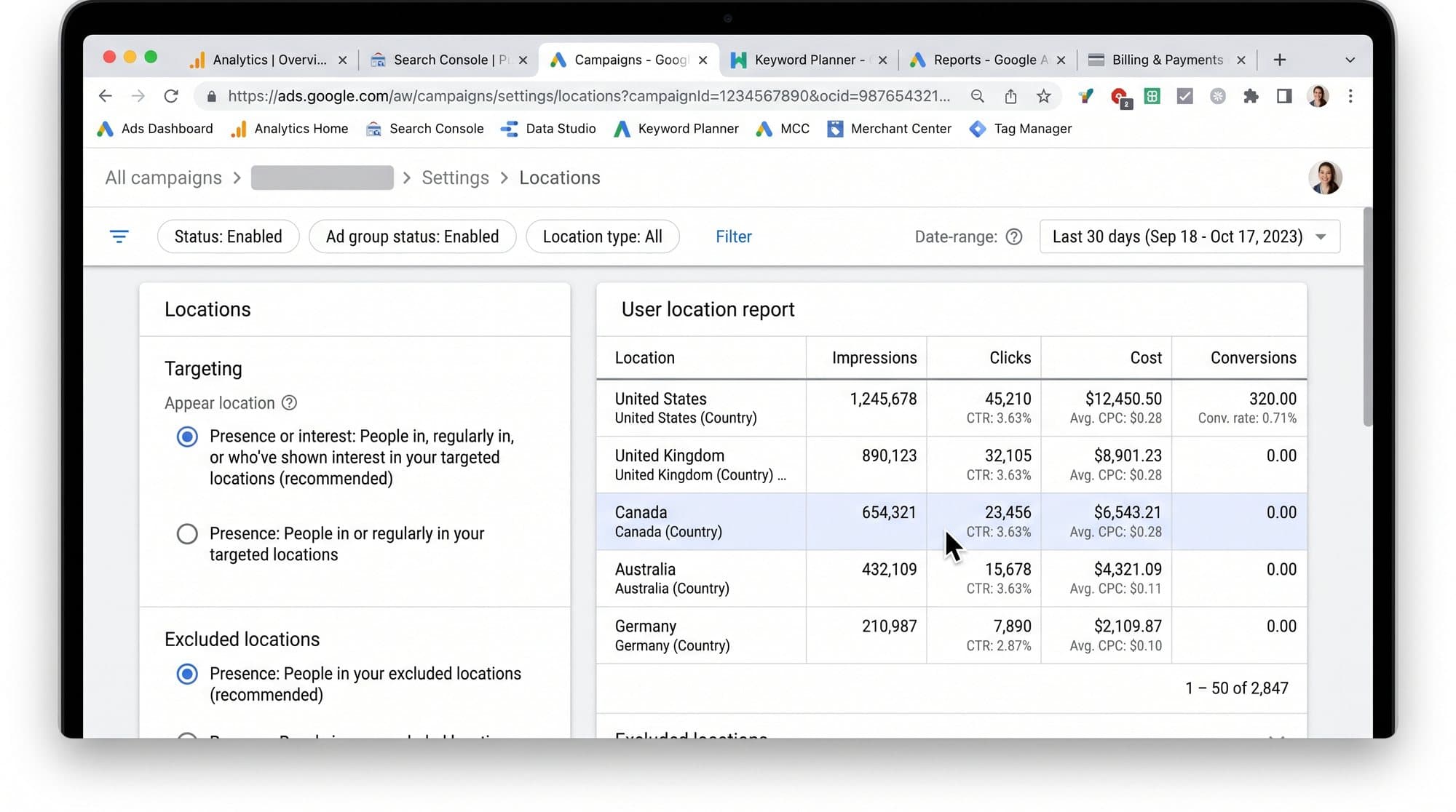
That's the anatomy of a default-setting leak: individually invisible, collectively a salary.
[IMAGE-2: Hyper-realistic screenshot of the Google Ads web interface, real left navigation and header chrome with the Google Ads logo, the campaign Settings page open on the Locations section showing the radio option "Presence or interest: People in, regularly in, or who've shown interest in your targeted locations" selected, with the alternative "Presence: People in or regularly in your targeted locations" visible unselected below it, and to the side a user-location report table with country rows where the non-target country names are visible generic country names and the spend column sums a visible "$9,412" subtotal, account name and customer ID covered by soft gray gaussian blur bars, a small red rectangular tag chip in the upper area reading exactly "EXHIBIT A" and one thin red rule running from the chip to the selected radio option, no other annotation, all visible UI labels real and correctly spelled, unimportant chrome rendered as soft gray bars, no border, no people, no faces, bottom tenth of the frame left clean for the footer composite.]
**Exhibit B: the machine was editing the account**
Auto-applied recommendations had been switched on seven months earlier, nobody remembered by whom. In those seven months the system had added broad-match keywords to eight search campaigns on its own. The audit pulled the query data on those auto-added terms: $14,700 a month in spend, conversion-time ROAS of 0.6x, and not one of them had been reviewed by a human, because auto-applied changes don't ask.
I'm not against automation. My whole operation runs on it. I'm against automation that edits accounts without leaving a decision for a person, which is a different thing entirely. My agents flag. This setting acts. The distinction is worth $14,700 a month here.
[IMAGE-3: Hyper-realistic screenshot of the Google Ads web interface, real chrome and logo, the Recommendations auto-apply history view showing a table of applied changes with a Date column, a Change column with rows reading "Added broad match keyword", "Added broad match keyword", "Added broad match keyword" across different dates spanning several months, and a Campaign column where every campaign name is covered by a soft gray blur bar, above the table the toggle row reading "Auto-apply recommendations: On" with an enabled toggle, account identifiers blurred, a small red rectangular tag chip reading exactly "EXHIBIT B" pinned near the toggle with one thin red rule pointing at the word "On", no other annotation, all visible UI labels real and correctly spelled, unimportant chrome rendered as soft gray bars, no border, no people, no faces, bottom tenth of the frame left clean for the footer composite.]
**Exhibit C: the quiet checkboxes**
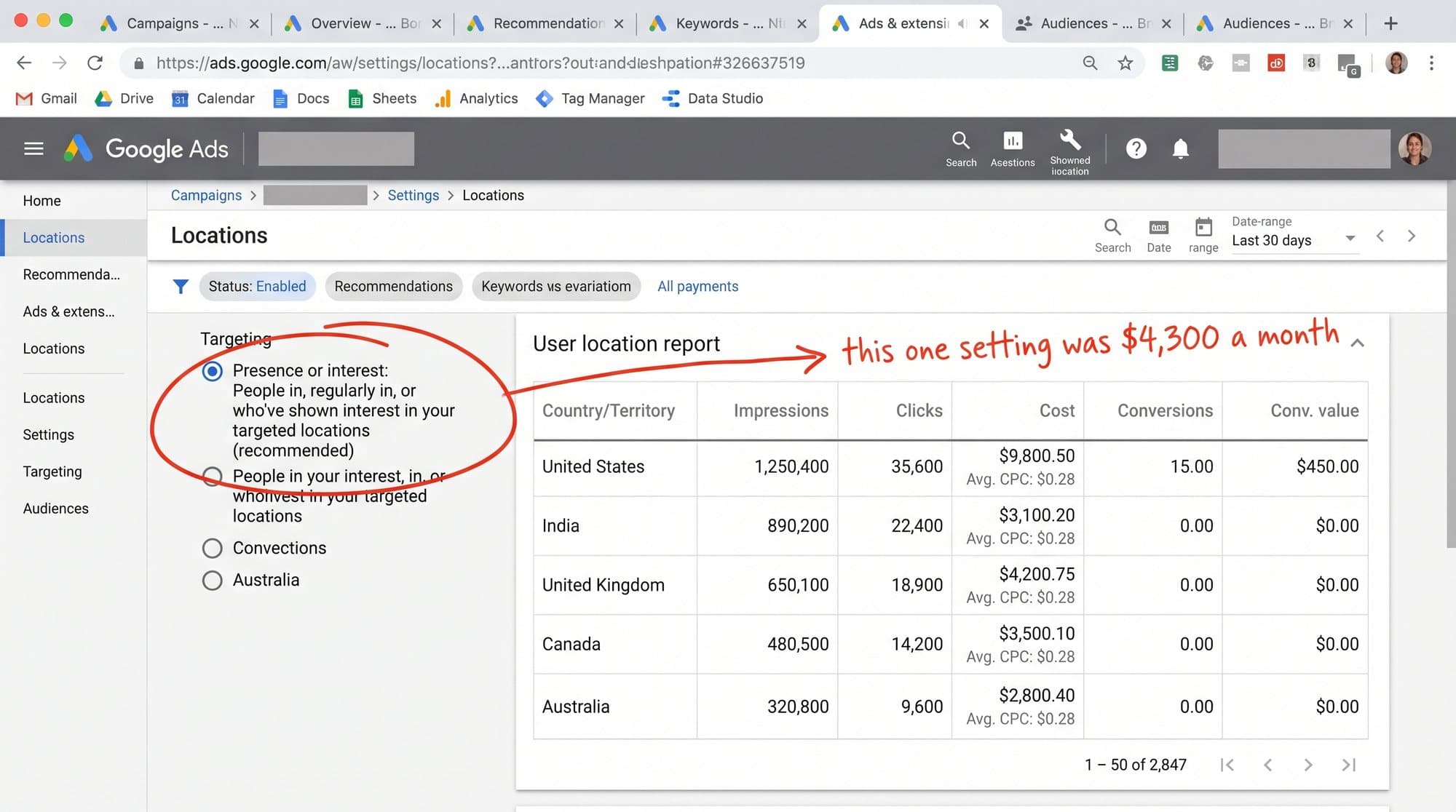
Every search campaign in the account had launched with the two default network checkboxes still ticked: search partners and Display expansion. Together they'd been carrying $8,200 a month of the budget at a blended 0.4x conversion-time ROAS, a tenth of what the core search placements returned. Two checkboxes, unticked in ninety seconds, that had cost roughly a hundred thousand dollars over the life of the account.
No screenshot for this one. You already know what a checkbox looks like. Go look at yours instead.
**Exhibit D: advertising products they couldn't ship**
The strangest leak took the longest to confirm. A PMax campaign was spending $12,000 a month promoting a product line the store had discontinued a quarter earlier. The items sat out of stock in the store, but the feed section behind them had never been paused, and the campaign kept happily buying traffic to pages where the buy button was dead. Click-time reporting even credited it with conversions, assist-credit from shoppers who bounced off the dead page and bought something else later.
The fix took four minutes. Finding it is what took the system: a cross-check between feed item availability and campaign-level spend that no monthly report ever runs.
**The after picture, 60 days out**
All four fixes shipped inside the first week, in order of size. The $44,300 stayed in the account and moved to the two campaign sets that had been earning above target all along. No new creative, no new strategy deck, no restructure theater. Sixty days later, same $520,000 budget: conversion-time ROAS at 3.4x, up from 2.3x. In revenue terms that's roughly $1.2M a month of tracked value climbing toward $1.77M, and the only thing that changed was where money stopped going.
[IMAGE-4: Clean before/after metric card illustration on an off-white #FAF7F2 background matching the edition's case file system: two large metric cards side by side connected by a thin horizontal timeline bar labeled with three small nodes reading "Day 1: access", "Week 1: four fixes", "Day 60: readout", the left card with a red top border, eyebrow "BEFORE", giant charcoal "2.3x", caption "conversion-time ROAS", sub-caption "$1.19M tracked monthly value", the right card with an emerald top border, eyebrow "DAY 60", giant emerald "3.4x", caption "conversion-time ROAS, same $520k budget", sub-caption "$1.77M tracked monthly value", beneath both cards one slim charcoal strip reading exactly "recovered and redeployed: $44,300/mo", flat clean design, no gradients, no photography, no logos, no border, all visible text real correctly spelled words, no people, no faces, bottom tenth of the frame left clean for the footer composite.]
**Why two years of reports missed it**
Monthly reports average. Averages hide. Every one of these leaks lived below the campaign level, in a settings page or a segment view the report never rendered, while the account-level line looked respectable enough to keep everyone comfortable. The agency wasn't malicious. It was reporting at the altitude where waste is invisible, and it had no system whose job was descending below that altitude every single day.
Worth naming the human part too, since the 40-minute number invites the wrong conclusion. The audit produced six flags that evening, not four. Two died under review: one "leak" was a geo test the founder had approved and forgotten to mention, another was seasonal stock rotation the feed handles on purpose. That's why the confirming hours matter and why they stay human. Flags are cheap. Findings cost verification, and an operator who ships flags as findings is just the auto-apply setting from Exhibit B with better branding.
Three checks you can run on your own account this week, ten minutes total: open location settings and count how many campaigns say presence or interest. Open the recommendations page and check whether auto-apply is on. Pull spend on search partners and Display expansion as segments. If any of those three surprises you, the other 220 checks would too.
Next edition is a mailbag: the five questions founders keep sending me, answered straight. Reply CASEFILE if you'd like your account run through the same evening treatment, anonymous and blurred like this one, in a future edition.