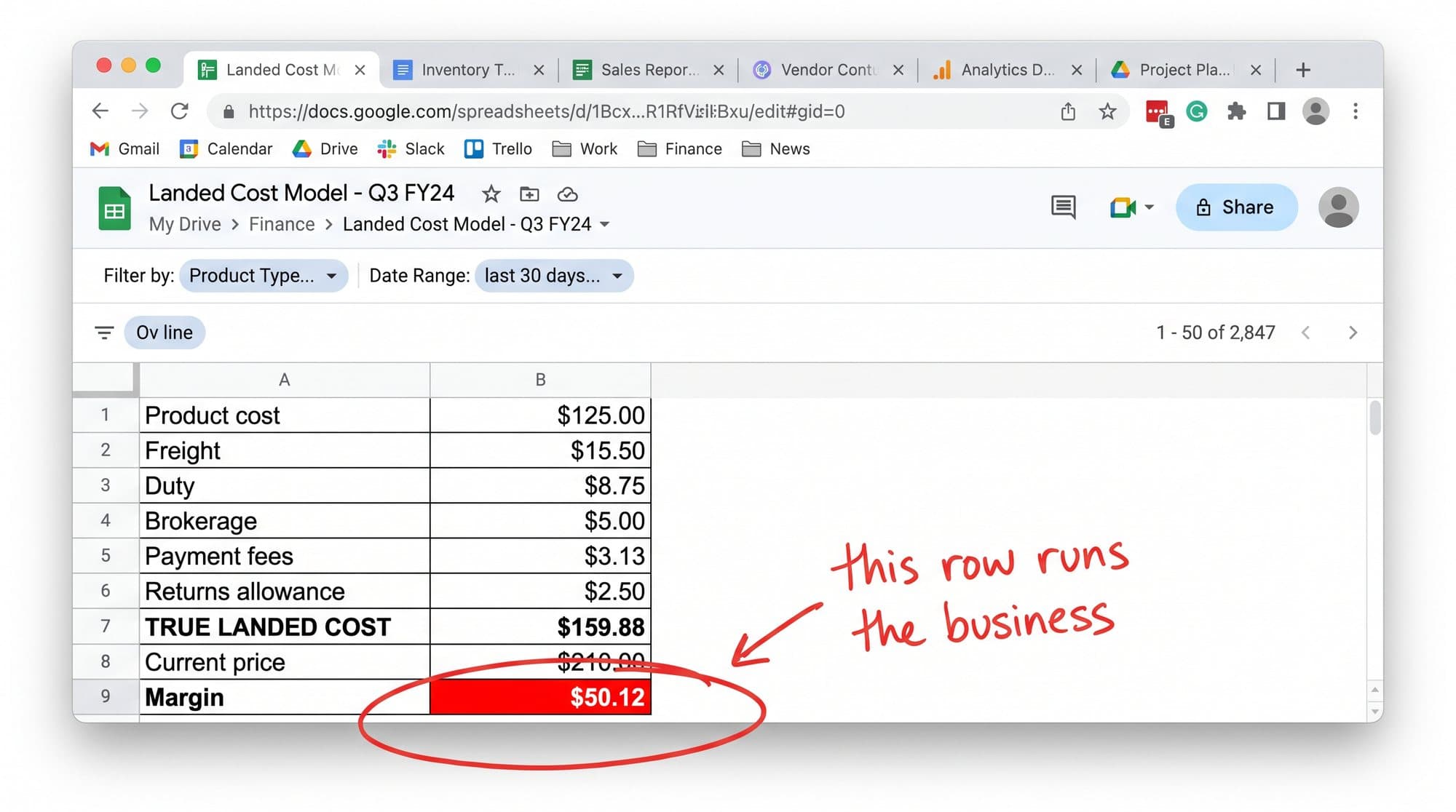
$412,000 came in. $41,600 stayed. That second number is the business.
Stephan Ochse ·

$412,000 came in last month. $41,600 stayed.
That second number is the one I look at, and it is the one almost nobody says out loud.
Go to any founder dinner and revenue comes up in the first ten minutes, usually rounded up. What almost never comes up is what was left after the money did its lap. There is a reason for that. Revenue is a story you get to tell about yourself. Margin is a fact about how you run.
Why ten percent is so hard to find
Here is the thing that makes a thin margin genuinely difficult to fix: it is never one problem.
If it were one big leak you would have found it already. You are not stupid and you look at your numbers. A thin margin is forty small leaks, each one individually too minor to justify an afternoon, which is exactly why every one of them survives year after year.
A discount code that was supposed to run for a weekend in 2024. A supplier price that moved 8% and never got passed on. A software seat for someone who left. Shipping quoted on your average order weight when a third of your orders are heavier than average. A payment processor rate you negotiated at a volume you have since tripled past.
None of those are worth a meeting. Together they are the difference between a business that funds your life and one that funds itself.
[IMAGE-1: Stripe dashboard showing ordinary payment volume and recent successful payments]
The monthly hour that pays for itself
Once a month I do the least interesting thing in my calendar. I open the costs, top to bottom, every line, and ask one question per line.
Would I sign up for this today, at this price, knowing what I know now.
Not "is this useful". Not "did we need this once". Would I buy it again, today, at that number. Anything that gets a no goes on a list, and the list gets worked, not admired.
The first time I did this it took four hours and found $6,100 a month. The fourth time it took forty minutes and found $400. That decay is the point. It is a maintenance task, not a project, and the reason it keeps working is that costs creep back in continuously while attention does not.
The three numbers that actually move margin
If you only touch three things, touch these.
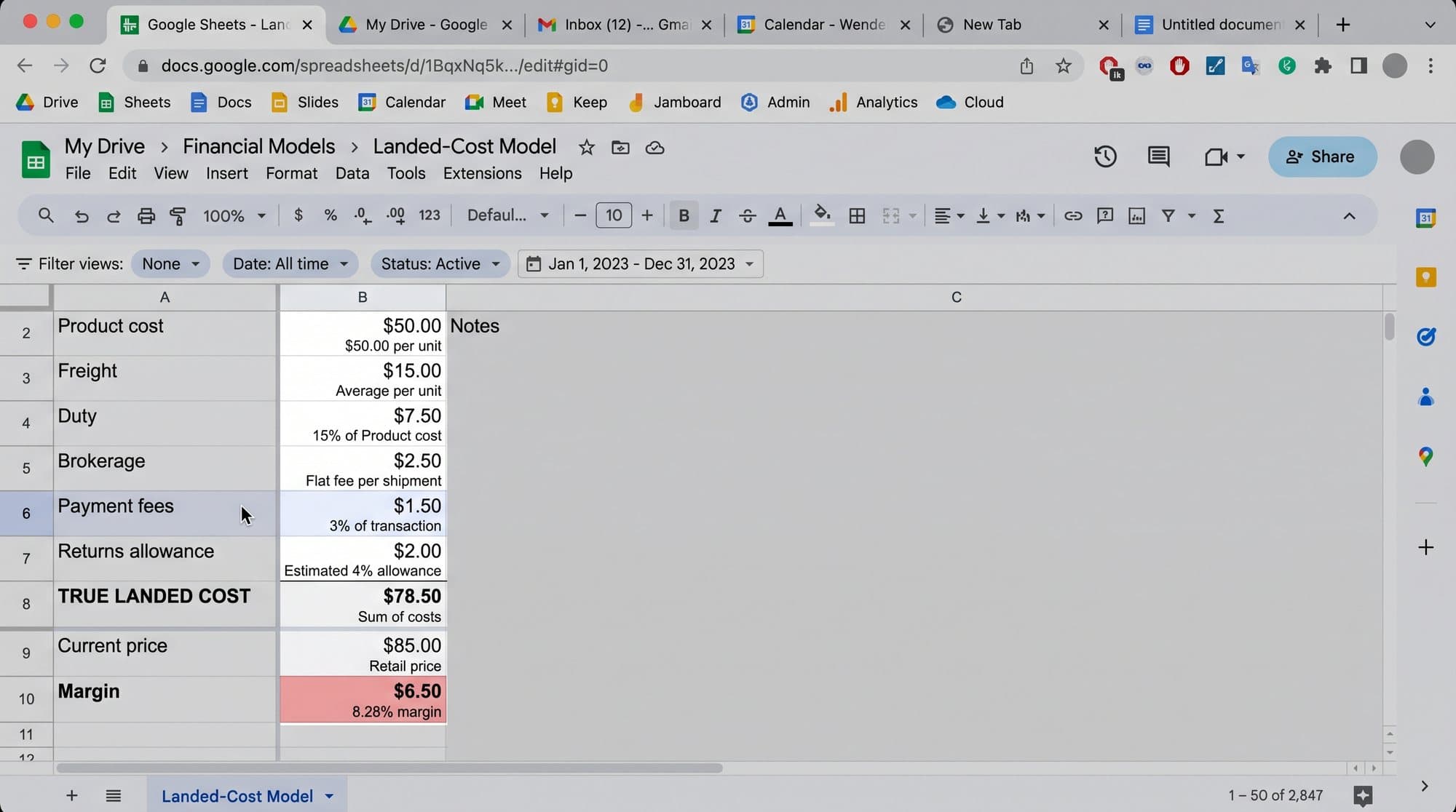
Landed cost per unit, recalculated. Not the number in the spreadsheet from when you launched. Product cost, freight, duty, brokerage, payment fees, and a real returns allowance. Most stores I look at are carrying a landed cost that is 15 to 30 percent higher than the one they price against, and they have no idea because nobody recalculated after the last supplier or tariff change.
Cost of acquiring one customer against what that customer is worth in ninety days. Not lifetime value. Ninety days, because that is roughly how long your cash can wait. If you cannot fund the gap, growth is not growth, it is a loan you are giving yourself at a bad rate.
The price itself. This is the one everyone avoids and it moves margin faster than any cost cut. A 5% price increase on a 12% margin business is not a 5% improvement.
[IMAGE-2: Shopify product editor showing the selling price, compare-at price, and cost per item on the product record]
It is closer to a 40% improvement in what you keep, and in most categories it costs you almost no volume. You will not believe that until you test it, so test it on ten products.
What i got wrong for two years
I optimised the top of the funnel because it was more fun. More traffic, better ads, new channels. All of it moved revenue and none of it moved what I kept, because I was scaling a machine that leaked at a fixed percentage.
Doubling revenue on a broken margin gets you a bigger, more stressful version of the same problem, with more people depending on it.
Fix the percentage first. Then scale it. That order is not a preference, it is arithmetic.
The landed cost walkthrough, line by line
Here is a real one, rounded, from a store doing about $400k a month. The product sells for $102.
Product cost from the supplier: $130 per unit on the last purchase order. Already a problem, and they did not know it, because the price in their sheet was $118 from an order eighteen months earlier.
Freight, insured, allocated per unit: $15. Most stores allocate freight by unit count. If your catalogue mixes light and heavy items, allocate by weight or you are quietly subsidising your heaviest products with your lightest ones.
Duty: $13. This is the line that moved most in the last two years and the line least likely to have been updated. If nobody has re-checked your tariff codes since the exemption changes, assume this number is wrong.
Brokerage and customs handling: $9. Almost nobody includes this. It shows up as an admin cost in a different part of the accounts and never makes it into the unit economics.
Payment processing: $3. Small, fixed, and fine, but it belongs in the number.
Returns allowance: $6. If your return rate is 12% and a return costs you the shipping both ways plus a portion that cannot be resold, that is a real per-unit cost on every unit you sell, not an occasional surprise.
True landed cost: $176. Selling price: $102.
[IMAGE-3: Google Sheet adding product cost, freight, duty, brokerage, payment fees, and returns into a true landed cost of $176 against a $102 price]
They were losing $15 on every unit of their second best selling product and had been for most of a year. Nobody was hiding it. Nobody had added it up.
The price test, exactly how to run it
Raising prices is the highest-leverage thing on this list and the one people refuse to do, so here is a protocol that removes the drama.
Pick ten products. Not your best sellers and not your worst. Middle of the catalogue, where a mistake is survivable and the signal is still real.
Raise them 5%. Change nothing else. Not the images, not the copy, not the ad budget pointed at them, nothing. If you change two things you learn nothing.
Leave it thirty days. Not fourteen. You need enough orders that normal week-to-week noise does not read as a trend, and most catalogues do not get there in two weeks.
Then compare units sold and total contribution, not revenue. Revenue can fall while what you keep goes up, and that is a win you will miss if you are watching the wrong number.
In most tests I have run, unit volume moves by less than the price change. That is the whole finding. People are far less price sensitive than the founder selling to them believes, because the founder has looked at the price ten thousand times and the customer has looked at it once.
The subscription audit, done properly
Open the card statements, not the app list. The app list only shows what you remember having.
Sort by amount, descending, and go down the list asking the one question. Would I buy this today at this price.
Three specific things to look for. Seats for people who have left, which is the most common and the most embarrassing. Annual plans auto-renewing at a tier you outgrew in both directions, above and below. And duplicate capability, where two tools do the same job because two different people chose them in two different quarters.
The first pass on a typical business finds between 4% and 9% of monthly software spend. It is not transformational on its own. It is the cheapest money you will ever find, and it takes an hour.
What margin is not
Margin is not frugality. I am not telling you to buy worse coffee.
Cutting costs has a floor and you hit it fast, and past that point you are damaging the thing that makes the money. The reason margin work matters is not that spending is bad, it is that a business with a healthy percentage can survive being wrong about something, and a business at 10% cannot. Margin is the room to make a mistake and still be here.
One last thing about growth
The reason margin work gets skipped is that it is invisible from the outside. Nobody congratulates you for a 3% improvement in contribution. They congratulate you for a launch.
But the businesses I watch survive downturns are never the ones with the best top line going in. They are the ones with enough room in the middle to be wrong for two quarters and still make payroll.
Growth gets the attention. The percentage decides whether you are still here to enjoy it.
Three things to do this week
Recalculate landed cost on your ten best sellers, including returns. Compare it to the number you priced against.
Open your last three months of card statements and cancel two things. There are two. There are always two.
Raise the price on your five lowest-margin products by 5% and leave it for thirty days without touching anything else.
Revenue is what you tell people at dinner. Margin is what you take home from it.