Five questions founders keep DMing me, answered straight
Stephan Ochse ·
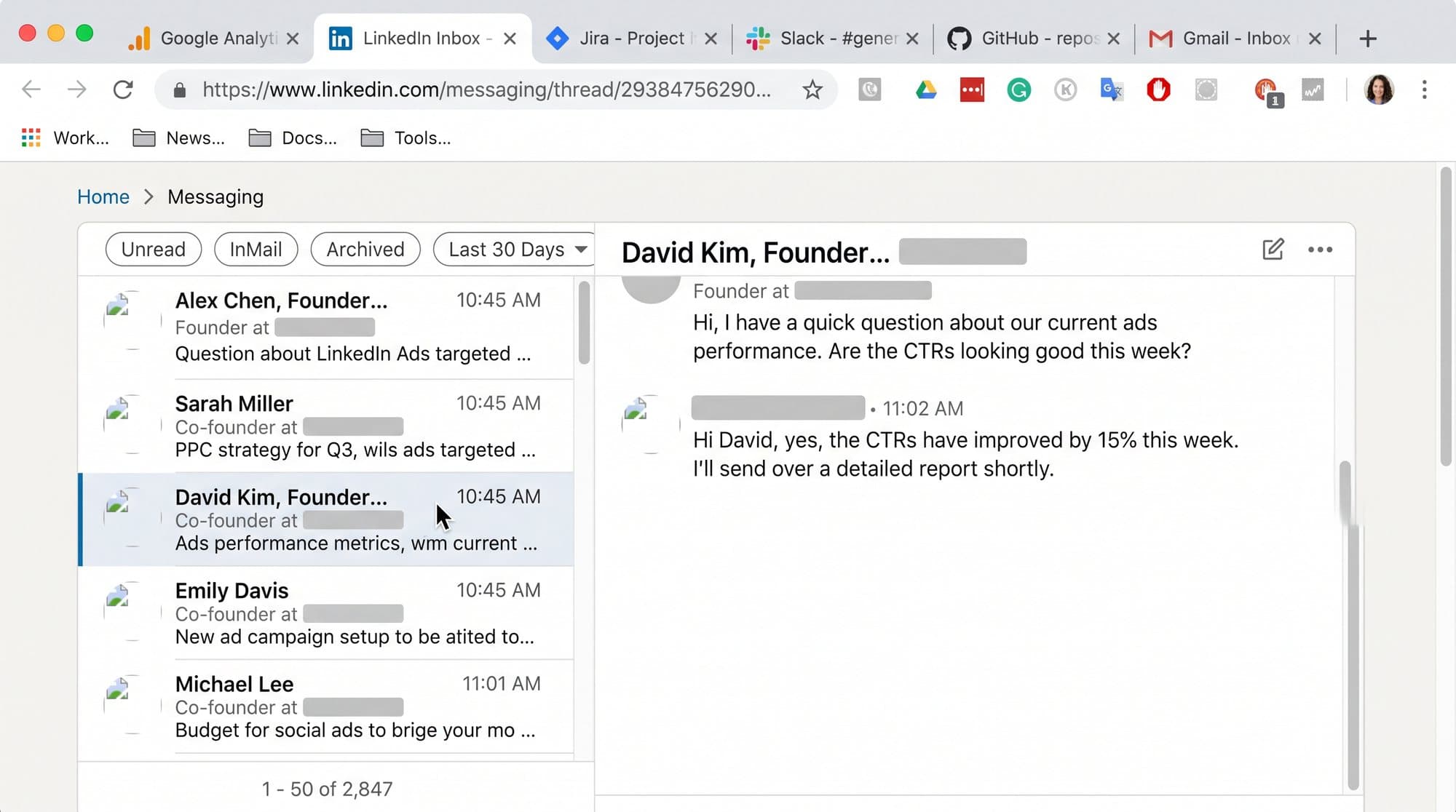
Five DMs, one week, and they're the same five questions I get every week. Different founders, different revenue, same worries. So this edition is a mailbag: real questions from my inbox, senders blurred, answered the way I'd answer across a desk. No pitch attached to any of them.
For the context that shapes the answers: I run 100+ Google Ads accounts at $300k to $2.5M a month through audit systems and AI agents. These answers come from that seat.
[IMAGE-1: Hyper-realistic screenshot of the LinkedIn messaging inbox interface, the edition's main image, real LinkedIn chrome with the LinkedIn logo and messaging pane layout, a list of five message previews stacked vertically, each row showing a circular avatar covered by a soft gray gaussian blur and a sender name covered by a soft gray blur bar, with the visible one-line message previews reading exactly "My agency reports 5.8x but revenue is flat", "Should I fire my agency and just use AI?", "What's actually a good ROAS?", "How much budget do I need for Google Ads?", "Which AI tools should my team use?", each row with a realistic timestamp like "2d" or "4d", one small emerald badge in the corner of the pane reading exactly "the weekly five", all visible UI labels real and correctly spelled, unimportant chrome rendered as soft gray bars, no border, no people, no faces (avatars fully blurred), bottom tenth of the frame left clean for the footer composite.]
**DM 1: "My agency reports 5.8x ROAS. Revenue is flat. Who's lying?"**
Usually nobody, and that's the uncomfortable part. Both numbers can be true at once. The agency's 5.8x is click-time platform ROAS: it counts revenue back to the click date, leans on branded searches that would have converted anyway, and takes credit the platform hands out generously. Your P&L counts money in the bank. The gap between those two rulers is where flat revenue and a green dashboard coexist for years.
The fifteen-minute check: pull total revenue from your store backend for last month, divide by total ad spend, and you have blended ROAS, the number no attribution model can argue with. Then switch your platform columns to conversion-time and strip branded campaigns out. If the gap between the agency's number and yours is bigger than about 40%, the reporting is decorating, not informing. That's not fraud. It's default settings serving whoever's being graded.
[IMAGE-2: Hyper-realistic chat-thread composition on an off-white #FAF7F2 background: at the top a single LinkedIn-style incoming message bubble rendered with real messaging UI styling, blurred circular avatar and blurred sender name, message text reading exactly "My agency reports 5.8x ROAS. Revenue is flat. Who's lying?", and beneath it a clean brand-styled reply card, off-white with an emerald left border, containing two small side-by-side metric tiles, the left tile with a gray eyebrow reading "WHAT THE DECK SAYS" and a large charcoal figure "5.8x" with a caption "click-time, brand included", the right tile with an emerald eyebrow reading "WHAT THE BANK SAYS" and a large emerald figure "2.1x" with a caption "blended, conversion-time", and one bottom line in charcoal reading exactly "both true. one useful.", flat clean design, all visible text real correctly spelled words, no border, no people, no faces, bottom tenth of the frame left clean for the footer composite.]
**DM 2: "Should I fire my agency and just run everything with AI?"**
Wrong question, and I say that as the person whose whole operation is agents. AI replaces tasks. It doesn't replace judgment, and judgment is what you were supposed to be buying from the agency in the first place. Fire the opacity, not the people.
What I'd demand from any agency in 2026, in one email: show me your daily checking system and how many checks it runs, show me reporting in conversion-time metrics with brand split out, and show me one example this quarter where you found your own mistake before I did. An agency that clears those three is worth more than its fee, with or without AI under the hood. An agency that can't clear them was already being outworked by a $200-a-month automation, and firing it changes less than you hope, because you'll still own the judgment gap yourself.
**DM 3: "What's a good ROAS?"**
There isn't one, and anyone quoting a universal number is selling something. ROAS is only meaningful against your gross margin. The math is one line: breakeven ROAS equals one divided by gross margin. At 30% margin you need 3.3x just to stop losing money. At 50%, 2.0x. At 70%, 1.4x. So a 2.4x account at 70% margin is comfortably profitable while a 4x account at 25% margin is quietly underwater, and I've audited both in the same week.
A good ROAS is one comfortably above your breakeven with enough headroom left to fund growth spend that deliberately runs below it. Measured at conversion time, blended against the bank. That's the whole answer, and it fits in a DM.
[IMAGE-3: Hyper-realistic chat-thread composition on an off-white #FAF7F2 background matching IMAGE-2's system: at the top a LinkedIn-style incoming message bubble with blurred avatar and blurred sender name reading exactly "What's actually a good ROAS?", beneath it a clean brand-styled reply card with an emerald left border titled exactly "BREAKEVEN = 1 / GROSS MARGIN", containing a minimal three-row table with column headers reading "GROSS MARGIN" and "BREAKEVEN ROAS", rows reading "30% | 3.3x", "50% | 2.0x", "70% | 1.4x", the 50% row softly highlighted in pale emerald, and a bottom caption line reading exactly "a good ROAS clears your row with room to grow", flat clean design, all visible text real correctly spelled words, no border, no people, no faces, bottom tenth of the frame left clean for the footer composite.]
**DM 4: "How much do I need to spend for Google Ads to work?"**
Enough to buy data, because the bidding systems run on it. The working floor I use: a campaign wants around 50 conversions a month before Smart Bidding has enough signal to do its job well. Below that, performance isn't bad so much as random, and random reads as bad. So the budget question inverts: instead of "how much should I spend," ask "how few campaigns can I run so that each one clears 50 conversions a month at my conversion value?"
A $15k account with two campaigns clearing the floor will beat a $15k account with nine campaigns starving below it, same targeting, same creative. Consolidate until every campaign you run is data-dense, and let budget growth follow proof instead of ambition. The accounts I run at $2.5M a month earned their structure one cleared floor at a time.
**DM 5: "Which AI tools should my team actually use?"**
The tool names change every quarter, so any list I give you is stale by the time you act on it. The jobs don't change. Automate these four first, in this order: the daily audit (checks against every account, every day, with dollar-sized flags), reporting (conversion-time numbers into a summary nobody has to assemble by hand), creative testing cadence (new variants entering the queue on a fixed clock), and pacing alerts (budget deviation caught the day it starts, not at month end).
Pick whatever tool does each job in your stack. The moment you catch yourself evaluating a sixth tool before those four jobs run without a human, close the tab. Tools are how this question gets procrastinated.
[IMAGE-4: Hyper-realistic chat-thread composition on an off-white #FAF7F2 background matching the edition's system: at the top a LinkedIn-style incoming message bubble with blurred avatar and blurred sender name reading exactly "Which AI tools should my team use?", beneath it a clean brand-styled reply card with an emerald left border titled exactly "AUTOMATE JOBS, NOT TOOLS", containing a vertical checklist of four rows each with an emerald filled checkmark circle and a numbered label, reading exactly "1. Daily audit with dollar-sized flags", "2. Conversion-time reporting, auto-assembled", "3. Creative testing on a fixed clock", "4. Pacing alerts the day drift starts", and a bottom caption line reading exactly "tool names expire. these four jobs don't.", flat clean design, all visible text real correctly spelled words, no border, no people, no faces, bottom tenth of the frame left clean for the footer composite.]
**The pattern under all five**
Read the five questions again and they're one question wearing five outfits: how do I know what's true in my own ad account? Attribution rulers, agency scorecards, margin math, data floors, automation order. Every answer routes back to measuring at conversion time, checking against the bank, and building a system whose job is telling you the truth daily so no single report, agency or tool gets to narrate your business to you.
That's also why this edition exists. The DMs keep coming because the defaults keep hiding the same things. Click-time flatters agencies, universal benchmarks flatter gurus, tool lists flatter vendors, and nobody's defaults flatter the person paying. Notice what none of the five asked about, too: keywords, bids, ad copy. Founders stopped asking tactics years ago. They ask about trust now, because the tactical layer got automated and the trust layer didn't.
One more from the cutting-room floor, answered in a line because it almost made the five: "Can I just copy a competitor's ads?" You can copy what they show. You can't copy their margin, their data density or their checked-daily account, and those three decide whether the same ad prints money or burns it.
Next edition goes back under the hood: the creative testing queue, and what 18 fresh ad variants every 14 days does to a stalled account at scale. And the mailbag runs again when five good questions stack up, so send yours: DM me the question you almost didn't send. Senders stay blurred, always.