$28,000 a month, or $1,900. What happened to the team.
Stephan Ochse ·

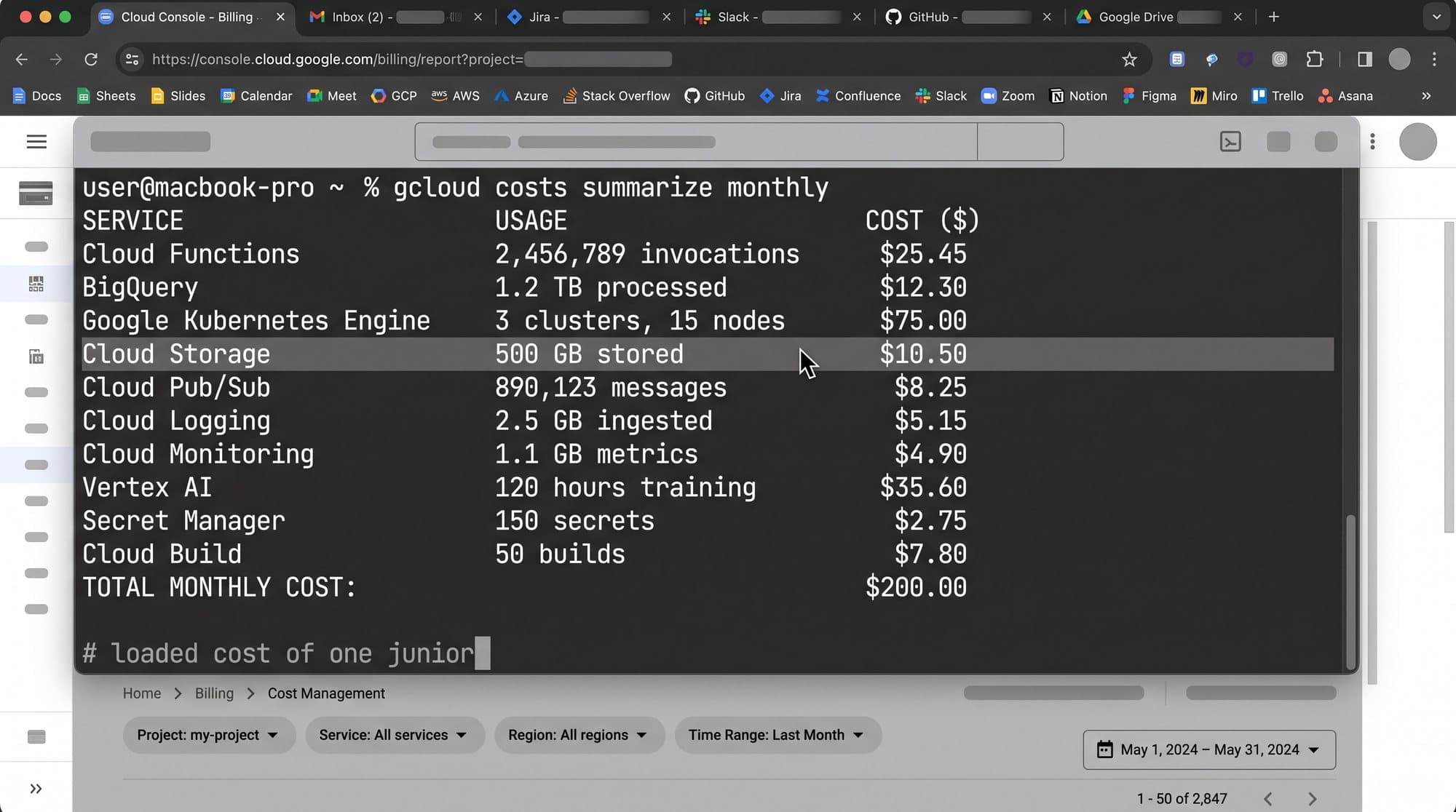
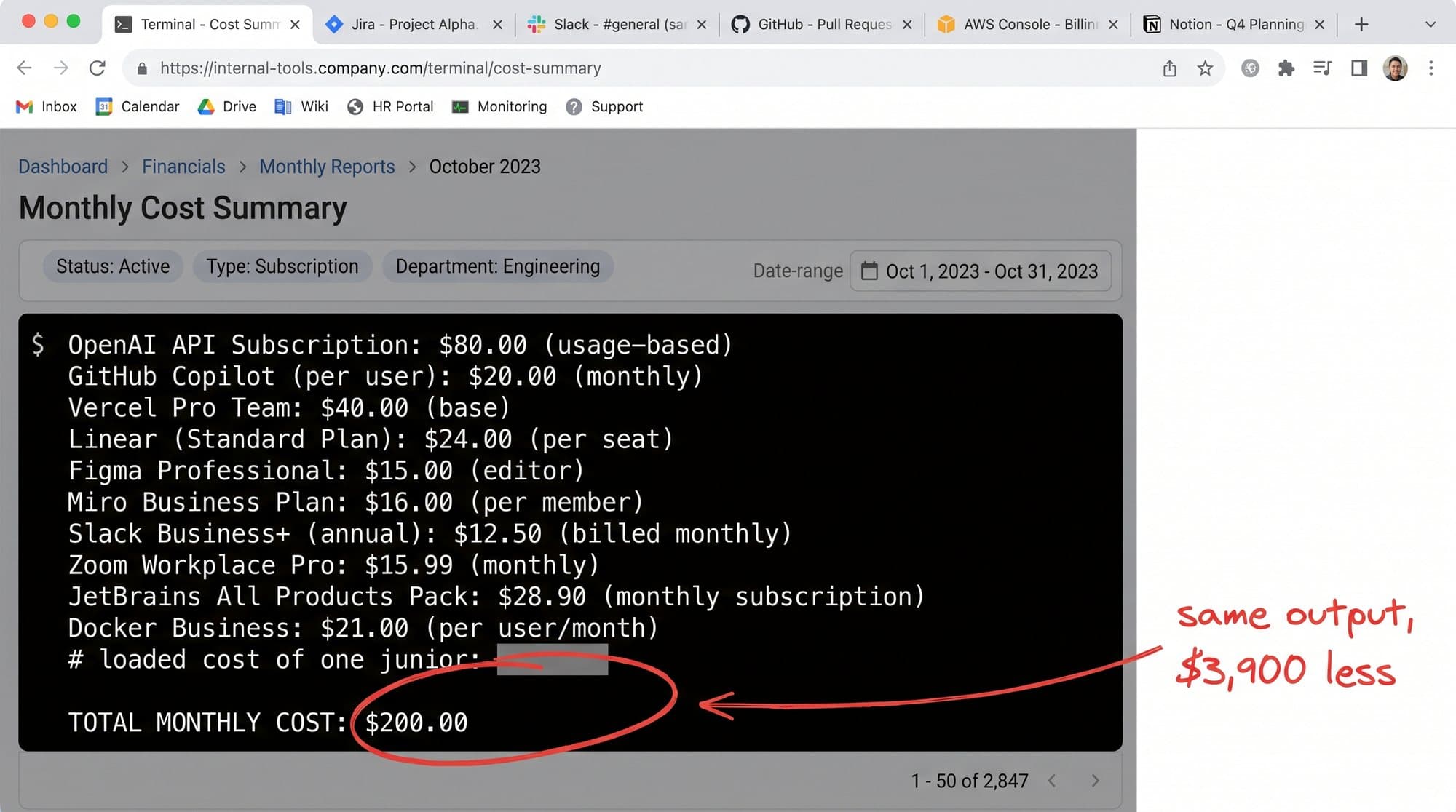
Two columns on a screen. Same output. One costs $28,000 a month and one costs $1,900.
I have shown that comparison to a handful of founders now and the reaction is always the same two questions in the same order. First: is that real. Then, quieter: what happened to the people.
Both fair. Here is the honest version, including the part that does not flatter me.
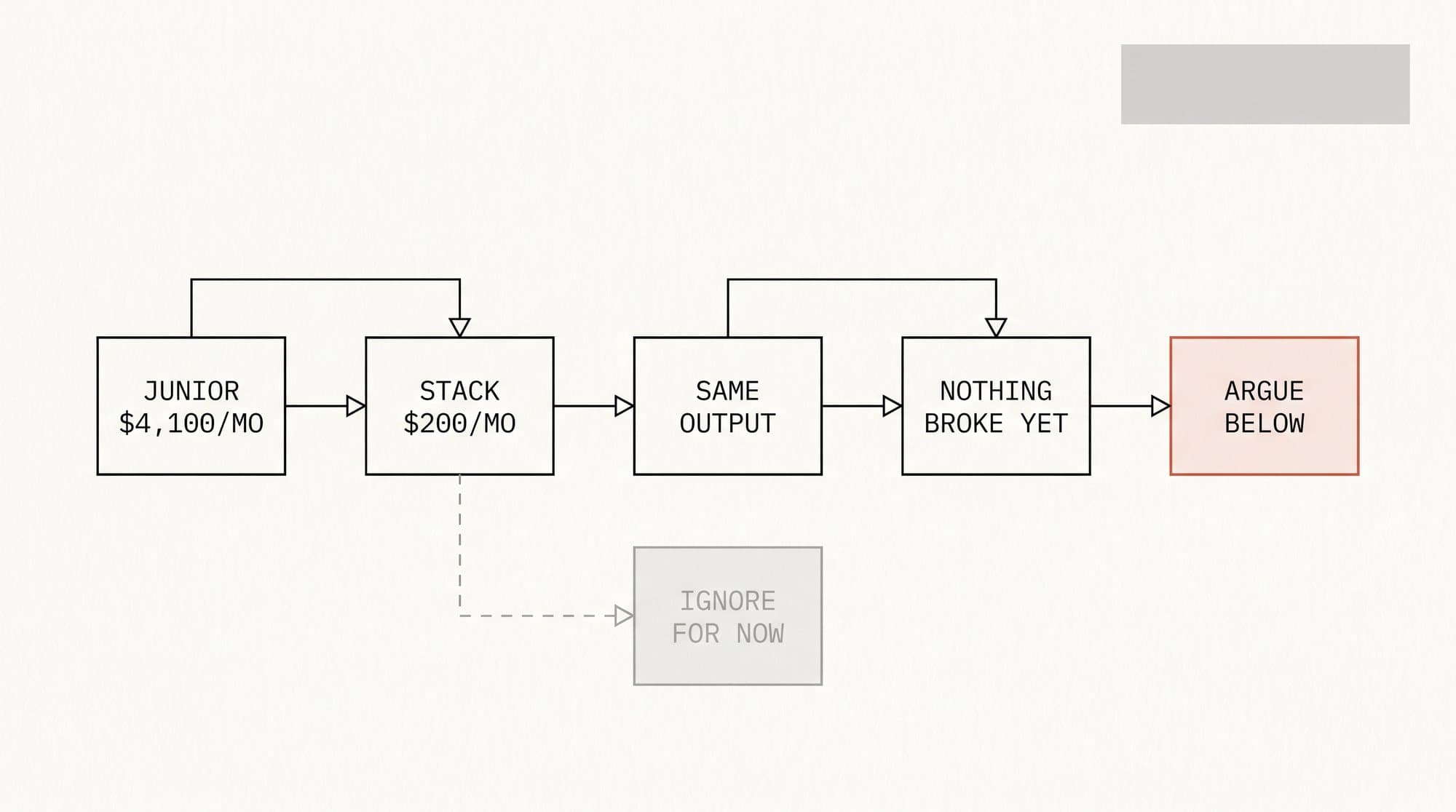
The comparison is real and it was not free
The right-hand column took about a year of work that produced nothing you could point at. No revenue, no launch, nothing worth posting. Just writing down how decisions actually get made, which is miserable work, because the first thing you discover is that most of them were never made consistently in the first place. You are not documenting a process. You are inventing one and pretending you are documenting it.
So when someone reads a chart like that and tries to jump straight to the right column, it fails. They cut the team, keep the same undocumented process, and six months later everything is worse and nobody can say exactly why.
The order matters more than the tools. Write the rules. Prove they hold for a quarter with the team still there. Only then does the cost structure move.
Do it backwards and you have not built a system. You have fired the people who were quietly holding the mess together, and you will find out how much they were holding within a fortnight.
The hire that almost always goes wrong
There is a specific hire that eats more money than any other, and almost every growing business makes it.
It is the capacity hire. Things are busy, everyone is drowning, so you hire hands. No clear scope, no defined decision rights, just "help".
That hire fails at a predictable rate, and it is not their fault. You handed someone an unwritten job and asked them to infer it. The good ones leave in seven months and take the context with them. The rest stay and quietly become another thing you manage.
Compare that to what a hire actually costs.
[IMAGE-1: First-year hire cost sheet adding salary, recruiting, ramp, management time, and rework into a $130,200 total]
Not salary. Recruiting, onboarding, the three to six months before they are net positive, your management time, the rework, and the risk they walk. Against that real number, a lot of hires never clear the bar, and the ones that do are almost never the capacity hires.
What to build and what to hire
The test I use now is boring and it works.
Is this genuinely judgement, or is it a decision I have already made a hundred times and keep re-making by hand.
Judgement is rare. Pattern is everywhere. Pattern does not need a salary, a laptop or a one-to-one. It needs a written rule and something that executes it, and the something can be software or a person following a checklist.
So I build for pattern and hire for judgement. That inverts the usual hiring profile: fewer people, more senior, more expensive individually, and each one owns decisions rather than tasks. The org chart stopped getting taller and started getting sharper.
The honest limitation
Leverage without judgement just lets you make the same mistake in more places at once, faster.
If the rule is wrong, you have now automated being wrong. That is genuinely worse than a slow team, because a slow team notices. A system does not notice anything. It does what you told it, at scale, at three in the morning, with total confidence.
Which is why the year of writing things down is not the boring prelude to the interesting part. It is the part.
What a hire actually costs
Salary is the smallest honest part of this number. Here is the arithmetic I run now, using a $70,000 role as the example.
Salary and employment costs: call it $84,000 all in once you add the employer side.
Recruiting: agency fee, or your own time, which is not free. Say $8,000 or three weeks of your attention, and your attention during a hiring process is worse than you think it is.
Ramp: three to six months before net positive on a role with any judgement in it. At a conservative four months, that is $28,000 of salary spent before the role returns anything.
Management: an hour a week of yours, plus the one-to-ones, plus the reviews. Say two hours a week of senior time.
Rework: the first quarter of anyone's output needs more checking. Real, rarely counted.
Attrition risk: if there is a one in three chance they leave inside eighteen months and take the context with them, you have to price that.
The first year of a $70,000 hire is closer to $120,000 of real cost. Which does not mean do not hire. It means the bar is much higher than the salary line suggests, and a lot of hires that look obviously worth it at $70,000 are not obviously worth it at $120,000.
The five decisions test
Before opening any role I write down the five decisions that job owns.
[IMAGE-2: Role document listing the decisions the hire owns, including refund approval, campaign pauses, and client-report sign-off]
Owns, meaning makes without asking me.
If I cannot name five, one of two things is true. Either the role is capacity rather than judgement, in which case I should be asking whether the work is pattern and can be written down instead. Or the role is real but I have not thought about it hard enough to hire for it yet, in which case hiring now guarantees a bad first ninety days for someone who deserved better.
The test takes ten minutes and it has stopped me opening more roles than it has approved.
What actually happened to the people
Since this is the question that always comes second, the honest answer.
Nobody was walked out. What changed is who I hire and what I ask them to do.
[IMAGE-3: Project board showing work across to-do, in-progress, done, and on-hold columns after the role boundaries are written]
I stopped hiring for capacity, which is the "we are drowning, get me hands" reflex every growing business has. I hire for judgement now. That is a different person: fewer of them, more senior, more expensive individually, and each one owning decisions rather than executing tasks.
The two people who were doing the most repetitive work moved onto the work that needed a human, which was client relationships and the calls where somebody has to read a room. Both are better at their jobs now and both would tell you the same, which I am aware is exactly what someone in my position would claim, so take it with whatever salt you like.
The roles that did not get refilled were the ones I would have opened, not ones anyone was sitting in. That distinction matters and it is the one people skip when they tell this story.
When hiring is still the right answer
I want to be clear about this because the automation crowd is dishonest about it.
Hire when the work is judgement under uncertainty. Hire when it needs a relationship, because relationships do not transfer to a system and clients know when they are talking to one. Hire when the failure mode of getting it wrong is expensive and irreversible. Hire when you need someone who will tell you that you are wrong, which is the single highest-return hire there is and the one founders avoid hardest.
Do not hire because you are busy. Busy is a symptom and hiring treats it the way a bigger house treats clutter.
One last thing about org charts
A taller org chart used to be the proof that something was working. More people meant more revenue, and more revenue meant you were winning.
That correlation has been broken for a while and most people have not updated. Headcount is now a cost you chose, not a score you earned, and in a lot of businesses the org chart is a record of which problems the founder avoided writing down.
Sharper beats taller. It is also much harder to post about.
Three things to do this week
Take the last role you hired for and write the five decisions that job owns. If you cannot name five, that was a capacity hire and the scope is the problem, not the person.
Pick the task you personally repeat most. Write the rule it follows, including the boundary where it stops and comes to you.
Work out the real cost of your last hire including ramp and management time. Compare it to what you assumed when you approved it.
You are not replacing people with software. You are deciding, on purpose, which decisions deserve a human.