18 new ad creatives every 14 days. Zero designers involved.
Stephan Ochse ·
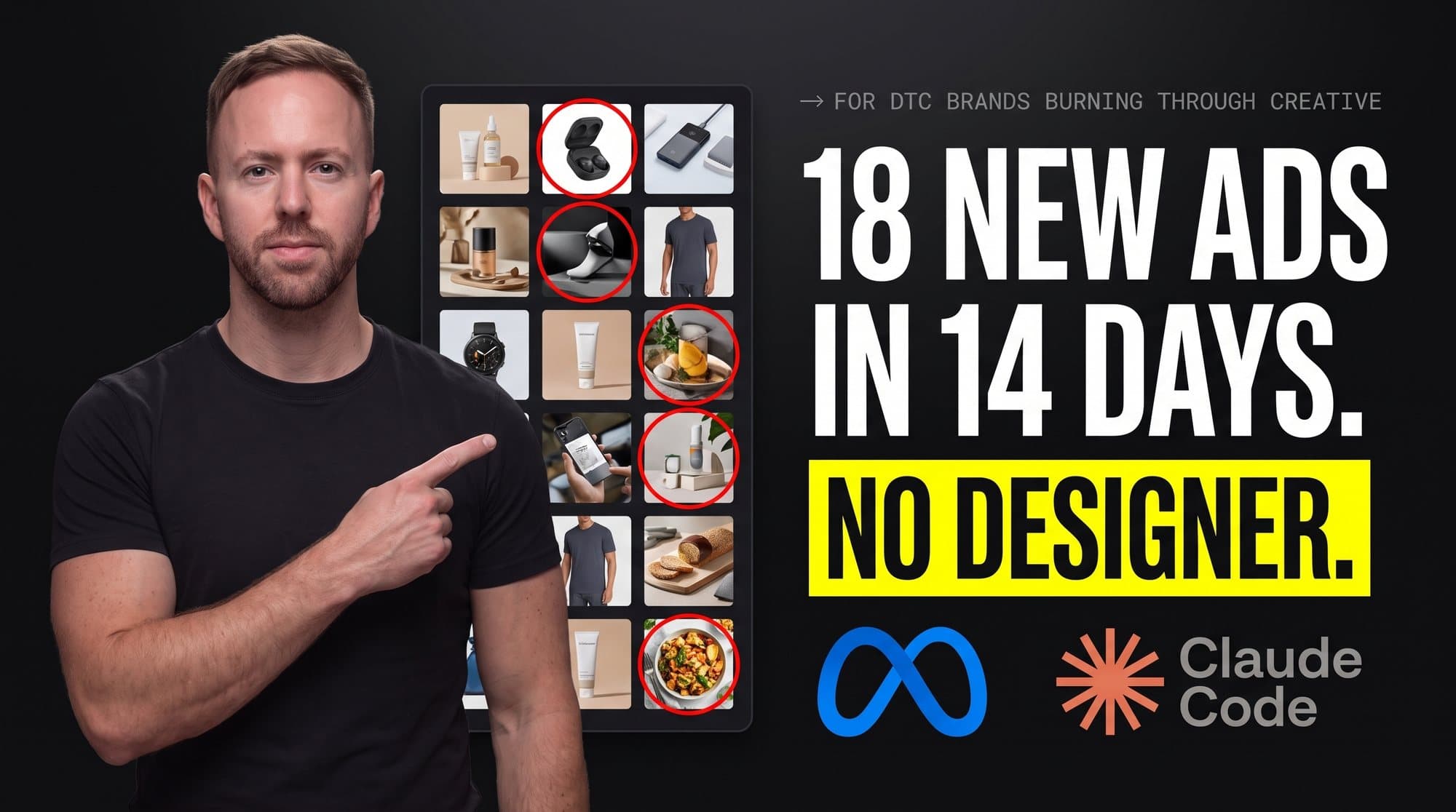
One ecommerce account in our book sat on the same four ad creatives for eleven weeks. $540,000 a month in spend, ROAS flat at 2.6x, and nobody upstream was refreshing the assets because refreshing assets meant a designer with a two-week queue of his own.
We built a system that pushes 18 new creatives into testing every 14 days, across every active account in the book, and none of them touch a design tool or a human hand. Here's how it runs and why the 14-day cadence matters more than the AI part does.
[IMAGE-1: Clean illustration-style diagram on an off-white #FAF7F2 background with emerald green accent lines, titled "The 14-day creative machine," showing four labeled nodes left to right connected by curved arrows: "Brief template" (a small document icon), "AI generation" (a small image-grid icon), "Brand QA gate" (a small checkmark-shield icon), "Live test queue" (a small rocket/campaign icon), with a small circular badge above the diagram reading "18 assets / 14 days," flat color blocks, no gradients, no invented logos]
**Why creative decays faster than most budgets account for**
Ad creative has a shelf life measured in days, not quarters. The same four images shown to the same audience for eleven weeks stop earning fresh attention long before the account manager notices the CTR slide. Google's own systems reward asset variety inside Performance Max and Demand Gen campaigns, feeding impressions toward whichever creative is still novel to the algorithm's own model of the audience. Run the same four assets past week six and you're not testing anymore. You're just paying the same tax on a smaller and smaller pool of people who haven't seen it yet.
Most agencies know this. Almost none act on it, because acting on it means a designer producing fresh creative on a two-week clock for every account in the book, and no agency staffs a design team deep enough to do that at 100+ accounts without the queue backing up into month two.
[IMAGE-2: Hyper-realistic screenshot of the Google Ads web interface, left nav visible with the Google Ads logo, a Performance Max asset group open showing an "Ad strength" meter reading "Good" and a grid of image assets with small "Impressions" and "Days active" labels beneath each, one column highlighted with a soft red tint showing "Days active: 78" next to a low impression share number, account name and campaign name blurred per standard practice]
**The machine, four steps**
The fix isn't a bigger design team. It's removing the designer from the loop entirely for the first draft and keeping a human only at the gate that actually needs judgment.
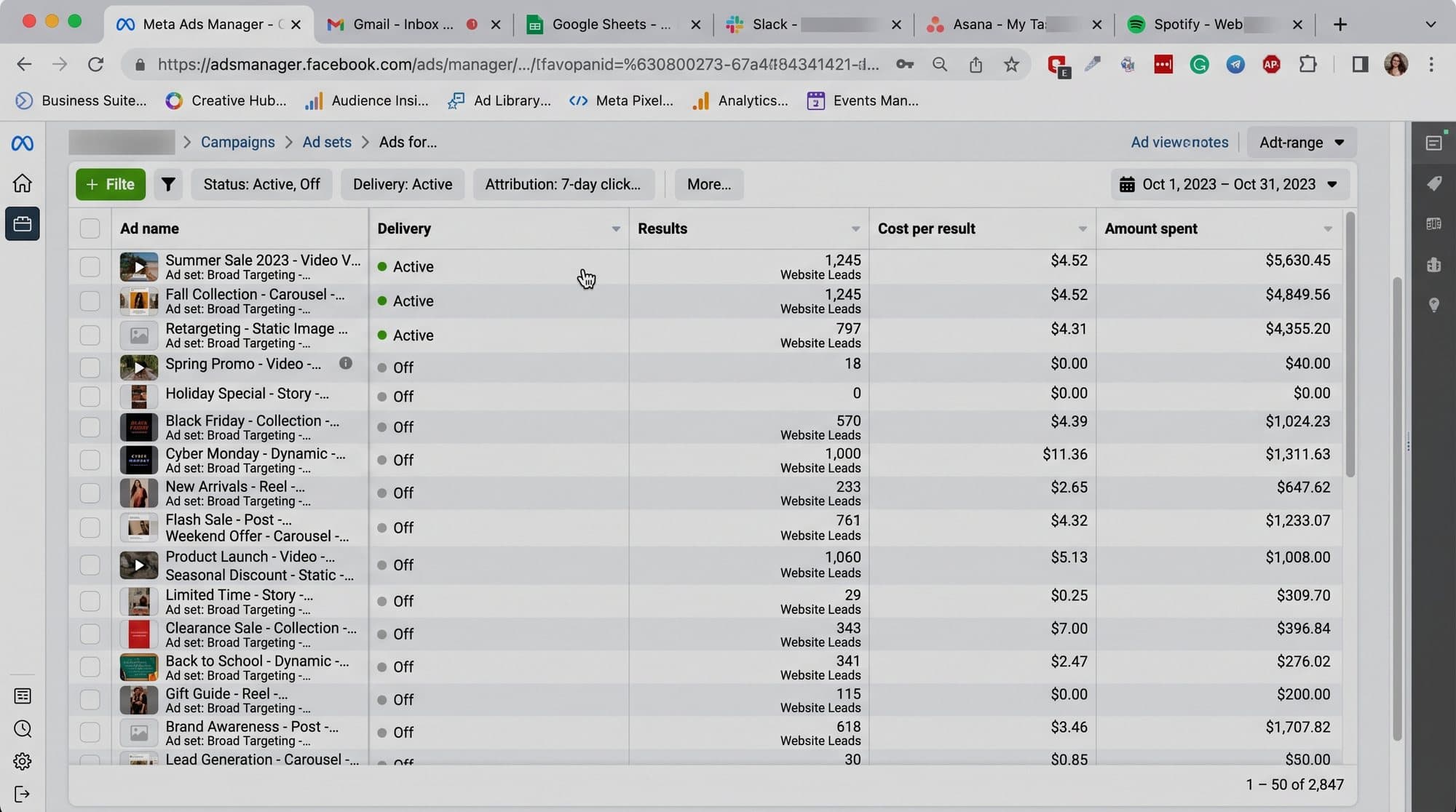
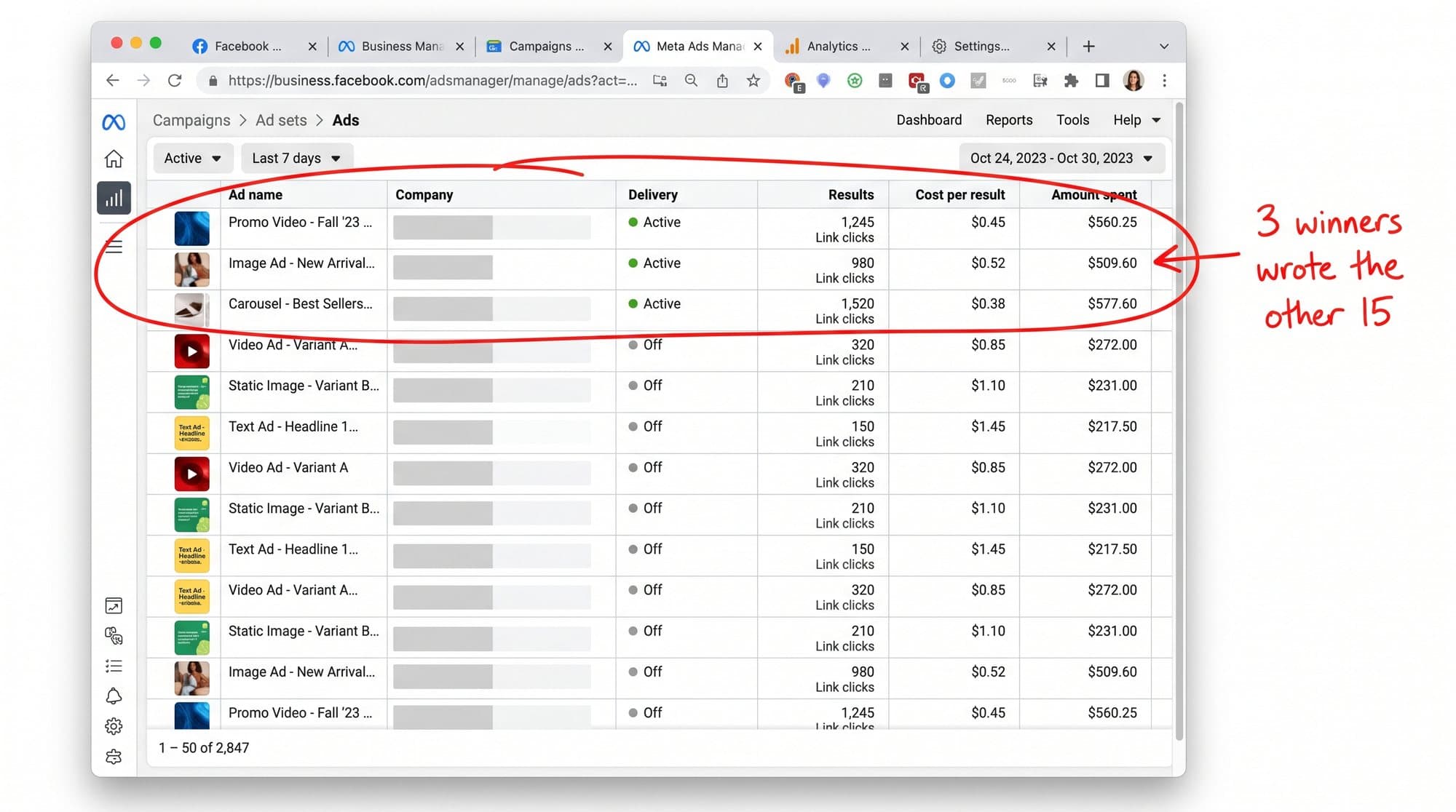
A brief template pulls the account's angle, offer, and brand assets into a structured prompt, no blank page, no back-and-forth over what the creative should say. An image model generates the full first pass, on-brand colors, real product shots, real logos where the account calls for them. Every asset clears a brand QA gate before it goes live: correct colors, correct claims, no invented text, no misspelled product names, client-identifying detail blurred where it needs to be. What survives the gate drops straight into the account's live test queue, no separate handoff, no waiting for a design sprint to free up.
The only step a person still owns is the gate. Everything before it runs without a queue.
[IMAGE-3: Side-by-side comparison illustration on an off-white background, two vertical columns divided by a thin emerald line, left column headed "Traditional pipeline" showing a small stick-figure-free designer-desk icon, a stack of 3-4 creative thumbnails, and a label reading "2-3 assets / 2 weeks," right column headed "The machine" showing an AI-generation icon feeding into a checkmark-shield icon feeding into a rocket icon, and a label reading "18 assets / 14 days," clean flat design, no photography, no invented brand names]
**What changed on the $540K account**
We ran the machine against that stalled account for three 14-day cycles, eighteen fresh creatives per cycle, fifty-four total, all cleared through the same brand gate as every other account in the book.
By the end of cycle one, CTR moved off its flat line for the first time in eleven weeks. By the end of cycle three, ROAS had climbed from 2.6x to 3.8x, holding monthly spend flat at $540,000. No new campaign structure, no new bidding strategy, no new offer. The only variable that changed was how often the account got something new to show the algorithm.
Multiply that cadence across the current book, over 100 accounts spanning $300k to $2.5M a month in managed spend, and it stops being a nice-to-have. It's several thousand tested creative variants moving through the queue every month, work that used to bottleneck on one person's design software and now doesn't touch it at all.
[IMAGE-4: Illustration-style line chart on an off-white background with an emerald green trend line, x-axis labeled "Cycle 1, Cycle 2, Cycle 3" (14 days each), y-axis labeled "ROAS," the line starting flat at "2.6x" and climbing to "3.8x" by cycle three, a small dashed horizontal reference line marking the original flat baseline, clean minimal chart styling, no other text or logos]
**Run a version of this without an agency**
You don't need our exact stack to borrow the mechanic. You need a brief template, an image model, and a gate that isn't optional.
Write down your account's angle, offer, and brand rules once, in a format you can paste into any AI image tool without rewriting it from scratch each cycle. Generate more variants than you think you need, since most of a batch gets cut at the gate anyway. Build the gate before you build the volume: a short checklist of what makes an asset on-brand and legally safe, checked the same way every time, by whoever is fastest at checking it, not necessarily whoever is best at design. Set a fixed cadence, 14 days works, and refuse to let a stalled queue push past it.
The bottleneck was never the creative. It was making a design team the only path an asset could take to get live.
[IMAGE-5: Realistic close-up photo-style render of a physical checklist card on a clipboard, off-white paper stock with emerald green checkmarks already ticked next to four items reading "On-brand colors," "Correct claims," "No invented text," "Client detail blurred," resting on a desk beside a laptop showing a grid of ad creative thumbnails in soft focus behind it, natural daylight, hyper-realistic paper texture, no other logos]
Next edition: the audience signal setup that decides which of those 18 creatives actually gets the impressions, and why most accounts feed Google the wrong signal without knowing it.
Got a creative queue that's stuck behind a designer right now? Reply and tell me the account size, I'll tell you where the machine would cut fastest. If this helped, forward it to whoever owns your ad account.
What actually produces eighteen
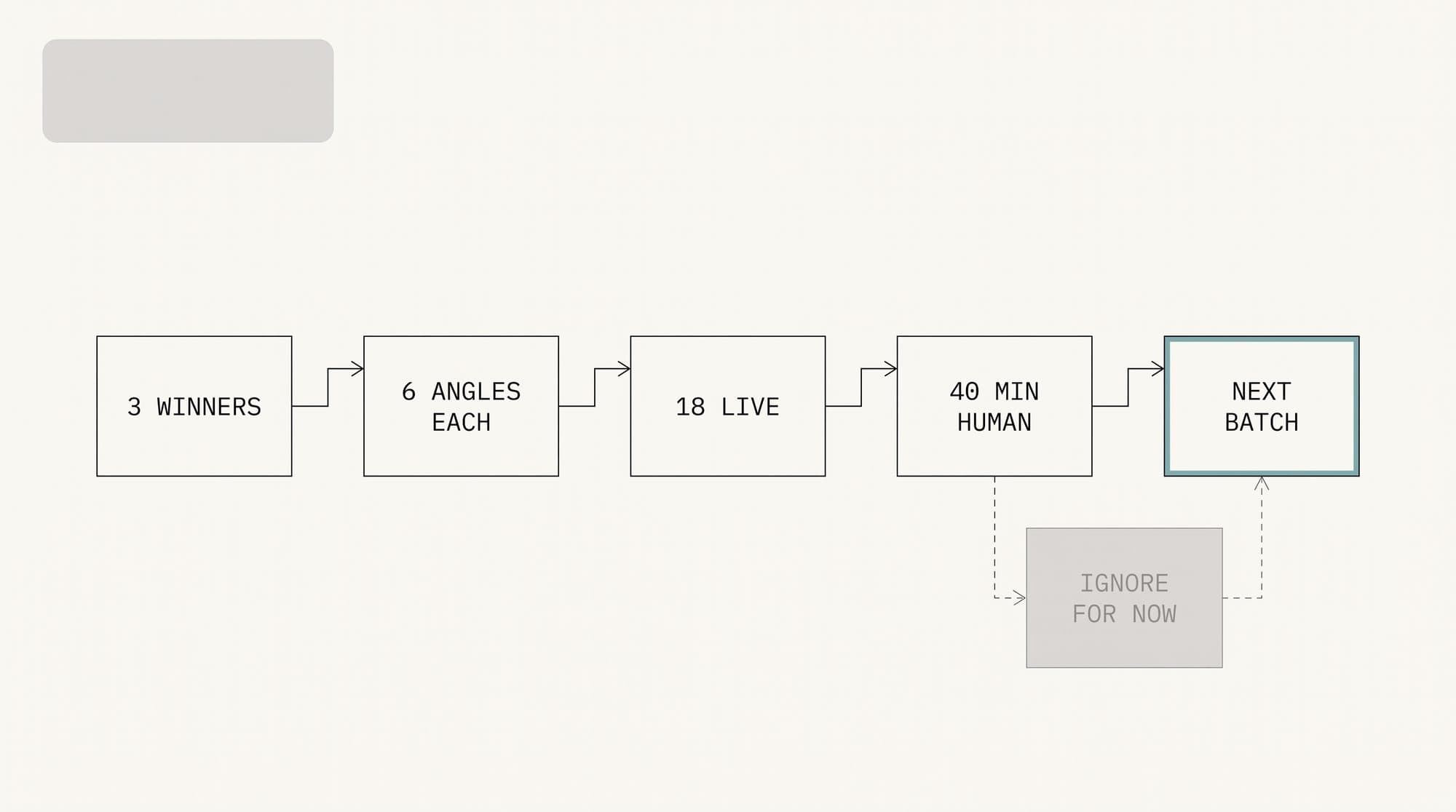
The number is not the interesting part. The interesting part is that creative volume is a systems problem, not a talent problem, and it breaks in the same place every time: the brief.
One brief format, filled the same way every time. The product, the buyer, the objection this piece answers, the proof, and the one thing it must not say. Five fields. Most creative bottlenecks are a vague brief being interpreted three different ways and rewritten twice.
A live asset library rather than a folder. Product shots, lifestyle, logos, approved claims, all in one place with a naming convention. Half the time in any creative process is spent looking for a file that exists.
Templates that carry the brand rather than the idea. The template settles colour, type and layout permanently so that every round of work argues about the message instead of the margins.
The review that keeps it moving
One reviewer, one pass, one deadline. Two reviewers doubles the time and halves the conviction, because the second reviewer feels obliged to add something.
Review against the brief, not against taste. "I do not like it" is not actionable. "This does not answer the objection in the brief" is.
Kill it or ship it in that pass. Anything that survives review with a maybe attached will consume more time than it is worth and usually ships late and diluted.
What to expect
Roughly a third will underperform the control, a third will match it, and a third will beat it. That distribution is stable and it is why volume matters more than any individual piece. You are not trying to make eighteen good ads. You are trying to find the two that work, and you cannot find them without making the other sixteen.